How to Choose a Reliable Pigment Red 177 Manufacturer in China
For manufacturers of coatings, plastics, masterbatch, printing inks, and other industrial products, choosing the right Pigment Red 177 supplier is an important part of maintaining stable product quality. Pigment Red 177 is a high-performance organic red pigment valued for its excellent light fastness, heat resistance, weather resistance, chemical stability, and strong color performance.
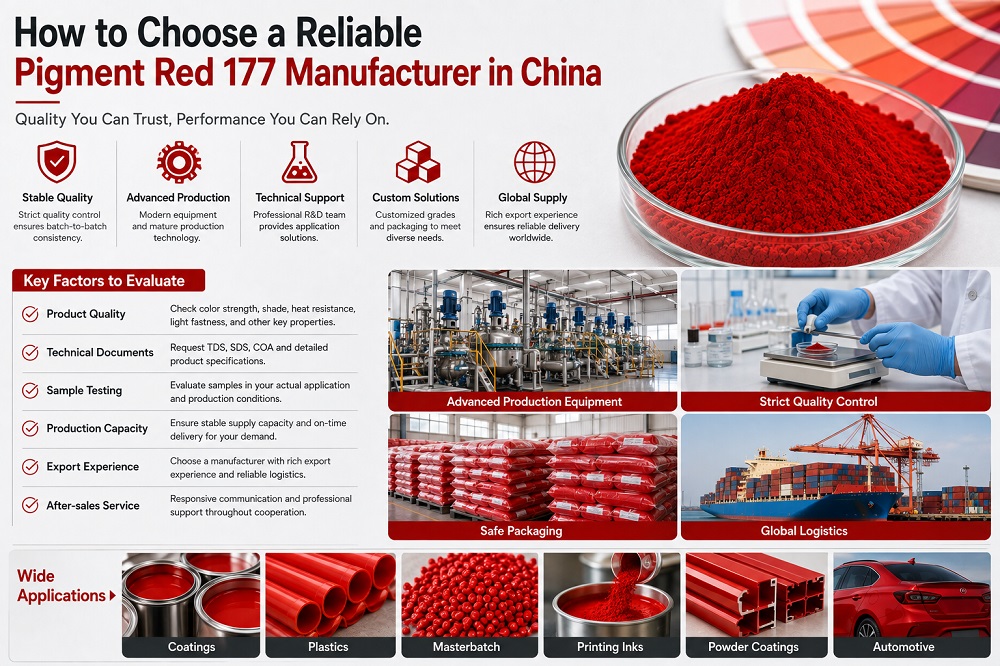
However, not every supplier offers the same product quality, technical support, production capability, or service level. When purchasing Pigment Red 177 from China, international buyers should evaluate more than price. Product consistency, technical documentation, quality control, customization capability, production capacity, and export experience can all influence the long-term success of a supplier relationship.
This guide explains how to evaluate a reliable ਪਿਗਮੈਂਟ ਰੈਡ 177 manufacturer in China and what international buyers should check before placing an order.
Why Choose a Pigment Red 177 Manufacturer in China?
China has become an important manufacturing and export base for organic pigments and other specialty chemicals. Chinese pigment manufacturers can offer a combination of production capacity, technical expertise, competitive pricing, and international supply capabilities.
For overseas buyers, working directly with a manufacturer can also provide better communication about product specifications, packaging, quality requirements, and application needs.
Competitive Manufacturing Costs
Direct sourcing from a Chinese manufacturer can help buyers achieve competitive material costs, particularly when purchasing Pigment Red 177 in commercial quantities.
However, buyers should compare total purchasing value rather than choosing a supplier based only on the lowest quotation. Product consistency, technical support, packaging, logistics, and quality control should also be considered.
Large-Scale Production Capability
Experienced pigment manufacturers may have established production facilities capable of supplying customers across different industries and international markets.
Stable production capacity is particularly important for customers that use Pigment Red 177 continuously in large-scale coating, plastic, or masterbatch production.
Technical Expertise
A professional Pigment Red 177 manufacturer should understand pigment performance in different application systems. Technical knowledge can help customers evaluate color strength, dispersion, heat resistance, light fastness, and compatibility with specific formulations.
What Is Pigment Red 177?
Pigment Red 177, also known as C.I. Pigment Red 177 or PR177, is a high-performance organic red pigment from the anthraquinone pigment family.
It is widely considered for applications that require durable red coloration and strong resistance to environmental and processing conditions.
Important Performance Characteristics
- Excellent light fastness
- Strong heat resistance
- Good weather resistance
- Good chemical stability
- High color strength
- Suitable for demanding industrial applications
- Useful for coatings, plastics, and masterbatch applications
The actual performance of Pigment Red 177 depends on the specific commercial grade, formulation, processing conditions, and end-use application. Buyers should therefore evaluate technical data and product samples before large-scale production.
Manufacturer vs Trading Company: What Should Buyers Choose?
One of the first questions international buyers should ask is whether they are purchasing directly from a Pigment Red 177 manufacturer or through a trading company.
Both types of suppliers can provide value, but direct manufacturers may offer advantages when buyers require technical communication, stable long-term supply, customized specifications, or application support.
Advantages of Buying Directly from a Manufacturer
- Direct communication with technical teams
- Better understanding of production processes
- More direct quality control
- Potentially more competitive pricing for larger quantities
- Greater customization possibilities
- Better visibility into production capacity
- Long-term supply cooperation
When a Trading Company May Be Useful
Trading companies can sometimes provide a wider range of products from multiple manufacturers and may be useful for buyers sourcing several types of pigments at the same time.
However, buyers looking for a long-term Pigment Red 177 supply partner should determine who actually manufactures the product and where production takes place.
Key Factors to Evaluate When Choosing a Pigment Red 177 Manufacturer
Before selecting a supplier, international buyers should evaluate several important factors rather than relying on price alone.
Product Quality
Product quality should be the first consideration. A reliable manufacturer should be able to provide consistent pigment performance from batch to batch.
Important characteristics may include color shade, tinting strength, particle characteristics, moisture content, purity, dispersion behavior, and thermal stability.
Batch-to-Batch Consistency
Consistent pigment quality is particularly important for coating and masterbatch manufacturers. Even small variations in pigment shade or strength can affect finished products and require formulation adjustments.
A professional manufacturer should have appropriate quality control procedures to monitor production batches and maintain stable product specifications.
Production Capacity
Production capacity should match the buyer's expected purchasing volume. A supplier may be able to provide samples but may not have sufficient capacity for regular commercial orders.
Before entering into a long-term agreement, buyers should understand the manufacturer's normal production capacity, lead time, minimum order quantity, and ability to handle increasing demand.
Check the Manufacturer's Technical Documentation
Technical documentation is an important indicator of a professional pigment supplier. Buyers should request complete and current product documentation before placing a commercial order.
Technical Data Sheet
A Technical Data Sheet, or TDS, should provide relevant product information and typical technical characteristics. Depending on the manufacturer, this may include color information, physical properties, recommended applications, and other product specifications.
Safety Data Sheet
A Safety Data Sheet, or SDS, provides important information related to safe handling, storage, transportation, and emergency measures.
Certificate of Analysis
A Certificate of Analysis, or COA, can be used to verify the quality characteristics of a particular production batch against the manufacturer's specifications.
Product Specification
Buyers should request a clear product specification covering the parameters that are important to their application. This creates a reference point for incoming quality inspection and future orders.
Evaluate Pigment Red 177 Sample Quality
Before purchasing large quantities, it is recommended that buyers evaluate a physical sample of Pigment Red 177 in their own laboratory or production environment.
A sample evaluation can provide much more useful information than a supplier quotation alone.
Color Shade Testing
Compare the Pigment Red 177 sample with the required color standard under controlled conditions. Color appearance can vary depending on concentration, dispersion, substrate, and formulation.
Tinting Strength Testing
Evaluate the relative color strength of the sample against the buyer's existing pigment or approved reference standard.
Dispersion Testing
For coatings, plastics, and masterbatch, dispersion performance is an important factor. Poor dispersion can result in uneven color, reduced color strength, surface defects, and inconsistent production.
Heat Resistance Testing
Plastic manufacturers should test the pigment under the actual processing temperatures used for extrusion, injection molding, compounding, or other production processes.
Light Fastness Testing
For outdoor applications, light fastness should be evaluated according to the expected service conditions of the finished product.
Consider the Application Before Choosing a Pigment Grade
Not all Pigment Red 177 applications have the same requirements. A pigment grade suitable for one formulation may not provide the optimal performance in another system.
Pigment Red 177 for Coatings
Coating manufacturers should consider color shade, tinting strength, dispersion, transparency or opacity, gloss, weather resistance, chemical resistance, and compatibility with the selected resin system.
Pigment Red 177 for Plastics
Plastic manufacturers should focus on heat resistance, dispersion, migration behavior, polymer compatibility, color strength, and long-term light stability.
Pigment Red 177 for Masterbatch
Masterbatch producers should evaluate pigment concentration, dispersion, carrier resin compatibility, thermal stability, color strength, and consistency during extrusion and downstream processing.
Pigment Red 177 for Printing Inks
Ink manufacturers may need to evaluate color strength, dispersion, solvent resistance, transparency, rheological behavior, and compatibility with the selected ink system.
Ask About Quality Control Procedures
A reliable Pigment Red 177 manufacturer should have clearly defined quality control procedures throughout the production process.
Raw Material Control
Consistent raw materials are an important foundation for stable pigment production. Manufacturers should have appropriate procedures for supplier qualification and incoming material inspection.
Production Process Control
Important manufacturing parameters should be monitored to reduce variations between production batches.
Finished Product Inspection
Finished Pigment Red 177 should be inspected according to established specifications before packaging and shipment.
Packaging Inspection
Packaging should protect the pigment from moisture, contamination, and damage during storage and international transportation.
Evaluate the Manufacturer's Customization Capability
Some buyers require more than a standard Pigment Red 177 product. They may need a particular color shade, strength, dispersion behavior, particle characteristic, packaging format, or application-specific performance.
In these situations, the manufacturer's technical development and customization capability becomes an important factor.
Color Customization
Depending on the manufacturer's capabilities, customers may be able to discuss specific shade requirements and color matching targets.
Application-Specific Recommendations
An experienced supplier can help customers evaluate whether a particular Pigment Red 177 grade is suitable for coatings, plastics, masterbatch, inks, or another application.
Packaging Customization
International customers may have specific requirements for packaging size, labeling, palletization, or transportation conditions. These requirements should be discussed before ordering.
Check International Export Experience
For overseas buyers, product quality is only one part of the purchasing process. International logistics and documentation can also affect delivery reliability.
Export Documentation
The supplier should understand the documentation requirements associated with international chemical and pigment shipments.
Packaging for International Transportation
Pigment packaging should be suitable for the expected transportation conditions and should help protect the product during handling, warehousing, and shipping.
Delivery Reliability
Reliable delivery schedules are important for manufacturers that depend on continuous pigment supplies. Buyers should discuss production lead times and shipping arrangements before placing regular orders.
How to Compare Pigment Red 177 Suppliers in China
When comparing multiple Chinese Pigment Red 177 suppliers, it is useful to create a structured evaluation rather than choosing based on the lowest price.
Product Quality
Compare technical specifications, sample performance, batch consistency, and quality documentation.
Price
Compare the total purchasing cost, including packaging, transportation, payment terms, and other relevant costs.
Minimum Order Quantity
Check whether the supplier's MOQ matches your purchasing requirements, especially when starting with a new supplier.
Lead Time
Evaluate whether the supplier can consistently meet your required delivery schedule.
Technical Support
Determine whether the supplier can provide technical assistance when problems occur during formulation or production.
Communication
Fast and accurate communication can significantly improve international cooperation. A supplier should be able to clearly answer questions about specifications, samples, production, packaging, and delivery.
Red Flags to Watch for When Selecting a Pigment Supplier
International buyers should also be aware of potential warning signs when evaluating a Pigment Red 177 supplier.
Unusually Low Prices
A quotation that is significantly lower than comparable suppliers should be investigated carefully. Buyers should confirm the actual product specification, grade, purity, and performance before making a decision.
Incomplete Technical Information
If a supplier cannot provide basic technical and safety documentation, buyers should carefully evaluate whether the supplier is suitable for long-term cooperation.
Inconsistent Samples
If different samples show significant variations in shade, strength, or physical characteristics, the supplier's batch consistency should be investigated further.
Unclear Manufacturing Information
Buyers should determine whether the company is an actual manufacturer, a trading company, or a combination of both.
Poor Communication
Slow or unclear responses during the initial purchasing process may become a larger problem when technical or quality issues arise after an order has been placed.
Questions to Ask a Pigment Red 177 Manufacturer
Before selecting a supplier, international buyers can ask several practical questions to better understand the manufacturer's capabilities.
- Are you the actual Pigment Red 177 manufacturer?
- What applications is your Pigment Red 177 grade designed for?
- Can you provide a TDS and SDS?
- Can you provide a COA for each commercial batch?
- What is the standard packaging?
- What is the minimum order quantity?
- What is the normal production lead time?
- Can you provide samples for laboratory testing?
- Can you support application-specific requirements?
- What export markets do you currently serve?
Why Long-Term Cooperation Matters
Pigment Red 177 is often used as part of a long-term production formula. Once a manufacturer qualifies a pigment and establishes a stable formulation, changing suppliers can require additional testing and color matching.
For this reason, it can be more valuable to establish a long-term relationship with a reliable Pigment Red 177 manufacturer than to change suppliers frequently based on short-term price differences.
Stable Product Supply
A long-term supplier relationship can help reduce supply uncertainty and simplify production planning.
Consistent Product Quality
Repeated purchasing from a qualified manufacturer can help maintain consistency once the pigment grade has been approved.
Technical Cooperation
Long-term cooperation can allow suppliers and customers to work together when developing new formulations or solving application problems.
Why Choose an Experienced Pigment Manufacturer?
An experienced pigment manufacturer can provide more than a container of red pigment. The manufacturer should understand how pigment characteristics influence the final product and should be able to communicate effectively with coating, plastic, masterbatch, or ink manufacturers.
For international buyers, the ideal Pigment Red 177 supplier should combine stable manufacturing, strict quality control, technical expertise, competitive commercial terms, and reliable export service.
Conclusion
Choosing a reliable Pigment Red 177 manufacturer in China requires a comprehensive evaluation of product quality, technical capability, production capacity, documentation, application experience, customization capability, and international supply experience.
Price is important, but it should not be the only selection criterion. A low-cost pigment that produces inconsistent color, poor dispersion, or insufficient durability can ultimately increase production costs and create quality problems.
For coatings, plastics, masterbatch, printing inks, and other industrial applications, buyers should request samples, review technical documents, conduct application testing, and compare suppliers based on total value.
By working with an experienced Pigment Red 177 manufacturer that provides stable quality, reliable supply, technical support, and professional international service, global buyers can build a more dependable supply chain and achieve consistent performance in their finished products.
ਸੰਬੰਧਿਤ ਉਤਪਾਦ
 Why Global Buyers Prefer Pigment Red 177 for High-Performance Industrial Products
- Pigment Red 177 Buying Guide: Everything Importers Need to Know Before Purchasing
- Pigment Red 177 vs Pigment Red 170: Which Organic Red Pigment Should You Choose?
- Pigment Red 177 Technical Data: Heat Resistance, Light Fastness, and Chemical Stability
- What Is Pigment Red 177? Properties, Applications, and Benefits Explained
- Why Pigment Red 177 Is Ideal for Plastic Coloration and Masterbatch Manufacturing
- Pigment Red 177 for Industrial Coatings: Why It Is the Preferred High-Performance Red Pigment
- How to Choose the Right Pigment Yellow 97 for Plastics, Coatings, and Inks
- Pigment Red 146: Properties, Applications, and Technical Guide
- What Is Pigment Red 146 and Where Is It Used?